Essential Worker Home Loans for AHPRA-Registered Professionals

Essential Worker Finance

Essential Worker Finance

Essential Worker Finance

1 Sep 2026

1 Sep 2026

/

4 min read

4 min read

/

Published by

AL Rizq Finance Editorial Team

A diverse group of Australian healthcare professionals reviewing home-buying information

Updated 8 Sep 2026

For an AHPRA-registered professional, preparing a home-loan application means bringing registration, income and deposit evidence together. Registration does not mean automatic approval. The useful question is how your profession, income mix, deposit and property plans fit a provider’s policy and the finance structure you are considering.

Who this guide is for

Ahpra’s National Registration and Accreditation Scheme covers 16 registered health professions. This guide is relevant to nurses, midwives, doctors, pharmacists, physiotherapists, psychologists, occupational therapists, paramedics and other registered professionals. The public register confirms registration; it does not guarantee finance approval.

What can make the application easier to assess

Stable PAYG income, consistent employment history, clear living expenses, a suitable deposit or equity position, and well-documented commitments can make an application easier to understand. If your income includes shifts, overtime, penalties, allowances or salary packaging, the pattern and evidence matter more than the job title alone.

Documents to prepare

Start with recent payslips, identification, bank statements, evidence of your deposit or equity, existing loan and credit commitments, HELP or HECS details, and property information when you have it. Keep supporting evidence for recurring overtime, shift allowances or other variable income ready if a provider asks for it.

A 5 percent deposit is a separate question

The Australian Government 5% Deposit Scheme has its own eligibility, property price caps, residency and owner-occupier rules, and participating-lender requirements. Being AHPRA registered does not automatically make you eligible, and scheme eligibility does not guarantee lender approval. Check the current official rules before relying on the scheme in your budget.

Questions worth asking early

How will recurring overtime and shift income be assessed? Which payslips, statements or employer evidence are needed? What deposit and property rules apply? What are the total payments and fees under the proposed structure? Could a different property price or deposit change the available options?
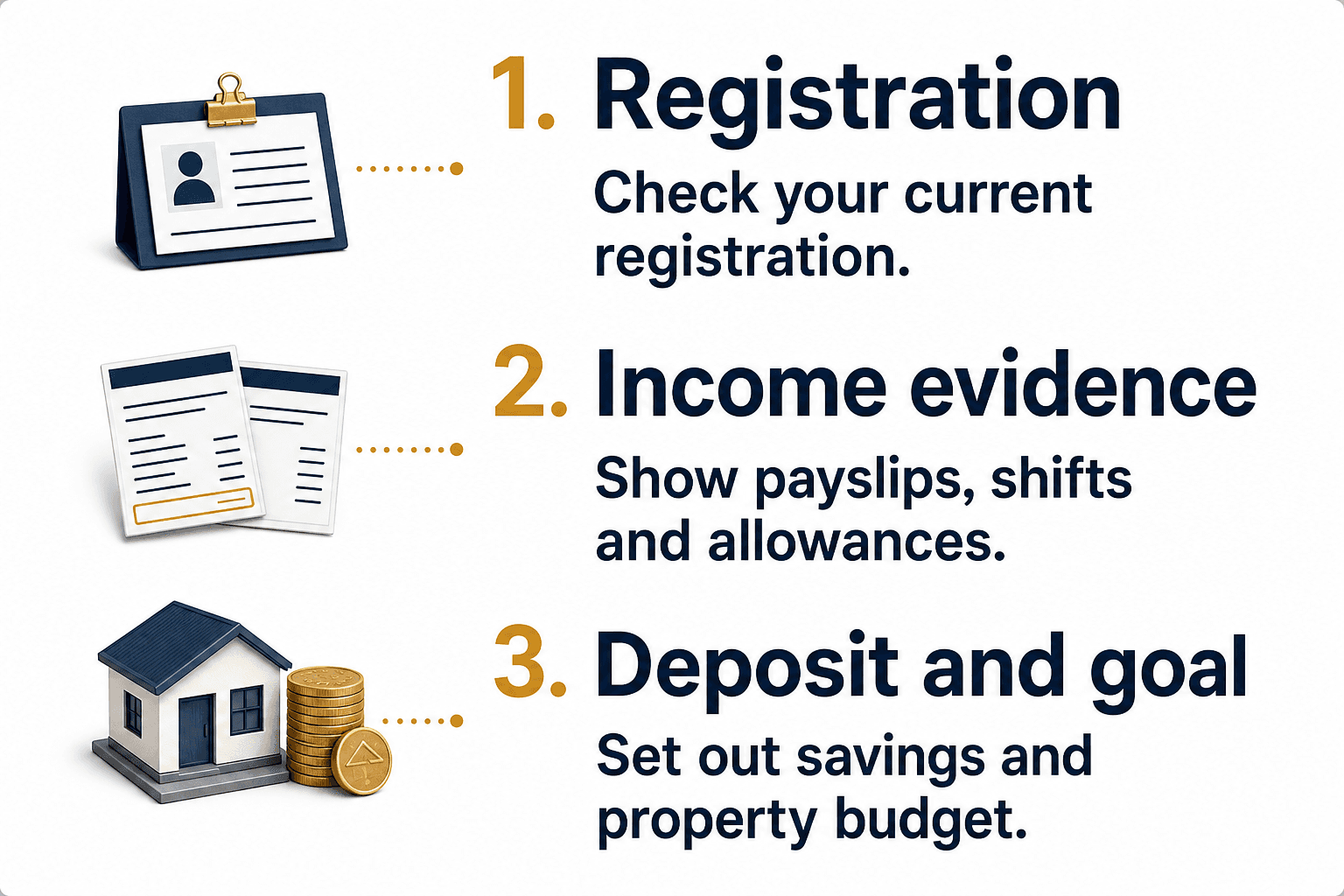
1. Registration: check your current registration. 2. Income evidence: show payslips, shifts and allowances. 3. Deposit and goal: set out savings and property budget.

Three different checks: registration, deposit and affordability

Think of these as three separate questions. Registration establishes your professional status. A lender's occupation policy determines whether that status changes the products or deposit options it will consider. Affordability assessment looks at whether the proposed payments fit your income, expenses and other debts. Passing one check does not answer the other two.

A lender-specific LMI waiver is also different from the Australian Government 5% Deposit Scheme. A waiver depends on that lender's eligible occupations and loan conditions. The government scheme depends on its own buyer, property and participating-lender rules. Ask which pathway is actually being discussed, whether LMI would be payable, and what the written conditions are. Start with the official scheme eligibility page.

Example: a registration-name mismatch

Consider a fictional nurse whose payslips use a new surname while their registration uses their former name. Start by checking the current register entry using the registered name or registration number. Ask which name-change evidence the provider needs to connect the records; do not alter the payslips or assume that an unsuccessful name search means no registration exists.

Ahpra's public-register guidance explains that the registered name can differ from the name someone is known by and recommends a current online check rather than relying on a printout. Matching the identity records resolves that evidence question only, not the separate lender or affordability checks.

Build a one-page evidence summary

  • Professional status: registered name, profession and registration number; explain any mismatch with identity documents.

  • Employment: employer, start date, permanent/casual/contract status and recent changes.

  • Income: base pay separately from overtime, penalties, allowances and packaging deductions, with the pay periods attached.

  • Home plan: approximate purchase range, available contribution and funds reserved for costs and emergencies.

  • Commitments: current balances, repayments and limits, including HELP/HECS and any salary-packaged vehicle commitment.

This is an organising tool, not a universal lender checklist. Ask which documents and periods the shortlisted provider requires before collecting unnecessary sensitive records. When overtime, penalties or allowances matter, use the shift and overtime evidence guide to reconcile them by pay period.

Common questions

Does AHPRA registration guarantee an LMI waiver?

No. Registration can be relevant to a provider's profession policy, but the eligible occupation, loan size, property and other conditions must all be checked. Do not budget on a waiver until the specific arrangement is confirmed.

Is every essential worker AHPRA registered?

No. Teachers and many other essential workers are outside Ahpra's health-profession register. Use evidence appropriate to your role. The first-home buyer guide for essential workers covers the wider preparation sequence.

What should I ask a broker to explain?

Ask which income amounts were included, which were reduced or excluded, and why. Our broker comparison guide explains how to assess the recommendation itself. Explore essential worker home loans when you are ready to connect the evidence with a finance discussion.

Sources and further reading

Published by AL Rizq Finance. General information only, not personal financial, legal, tax or religious advice. Examples are illustrative; provider criteria and individual circumstances apply.

Three different checks: registration, deposit and affordability

Think of these as three separate questions. Registration establishes your professional status. A lender's occupation policy determines whether that status changes the products or deposit options it will consider. Affordability assessment looks at whether the proposed payments fit your income, expenses and other debts. Passing one check does not answer the other two.

A lender-specific LMI waiver is also different from the Australian Government 5% Deposit Scheme. A waiver depends on that lender's eligible occupations and loan conditions. The government scheme depends on its own buyer, property and participating-lender rules. Ask which pathway is actually being discussed, whether LMI would be payable, and what the written conditions are. Start with the official scheme eligibility page.

Example: a registration-name mismatch

Consider a fictional nurse whose payslips use a new surname while their registration uses their former name. Start by checking the current register entry using the registered name or registration number. Ask which name-change evidence the provider needs to connect the records; do not alter the payslips or assume that an unsuccessful name search means no registration exists.

Ahpra's public-register guidance explains that the registered name can differ from the name someone is known by and recommends a current online check rather than relying on a printout. Matching the identity records resolves that evidence question only, not the separate lender or affordability checks.

Build a one-page evidence summary

  • Professional status: registered name, profession and registration number; explain any mismatch with identity documents.

  • Employment: employer, start date, permanent/casual/contract status and recent changes.

  • Income: base pay separately from overtime, penalties, allowances and packaging deductions, with the pay periods attached.

  • Home plan: approximate purchase range, available contribution and funds reserved for costs and emergencies.

  • Commitments: current balances, repayments and limits, including HELP/HECS and any salary-packaged vehicle commitment.

This is an organising tool, not a universal lender checklist. Ask which documents and periods the shortlisted provider requires before collecting unnecessary sensitive records. When overtime, penalties or allowances matter, use the shift and overtime evidence guide to reconcile them by pay period.

Common questions

Does AHPRA registration guarantee an LMI waiver?

No. Registration can be relevant to a provider's profession policy, but the eligible occupation, loan size, property and other conditions must all be checked. Do not budget on a waiver until the specific arrangement is confirmed.

Is every essential worker AHPRA registered?

No. Teachers and many other essential workers are outside Ahpra's health-profession register. Use evidence appropriate to your role. The first-home buyer guide for essential workers covers the wider preparation sequence.

What should I ask a broker to explain?

Ask which income amounts were included, which were reduced or excluded, and why. Our broker comparison guide explains how to assess the recommendation itself. Explore essential worker home loans when you are ready to connect the evidence with a finance discussion.

Sources and further reading

Published by AL Rizq Finance. General information only, not personal financial, legal, tax or religious advice. Examples are illustrative; provider criteria and individual circumstances apply.

Essential worker home loans

See how your income and profession may shape your options

Talk through your role, income, deposit and property plans before you make an application.